Compiled Config as an OCI Artifact: Atomicity in Production with Kargo#
The complete problem of auto-sync + atomicity + multi-region. The five alternatives I evaluated. The solution with OCI artifacts. The complete PromotionTask. The test results. And why your compiled config deserves the same treatment as your Docker image.
I’ve spent weeks solving a problem that seemed simple and ended up being a redesign of how compiled config reaches production. The short version: auto-sync in production + config as a file in git + multiple regions = a ticking time bomb. Here’s everything I tried, what I discarded, and what became an ADR.
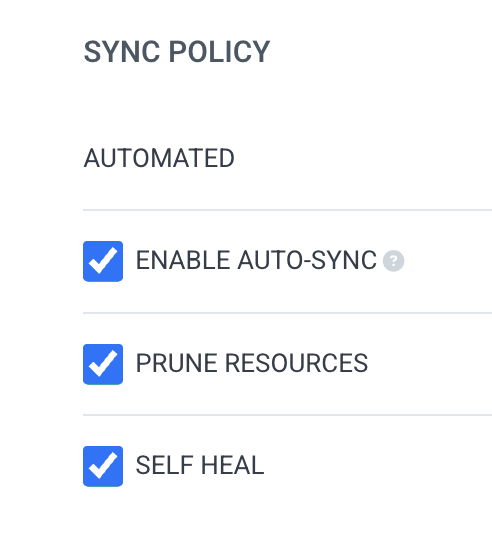
Production runs with ArgoCD in auto-sync. selfHeal: true, prune: true. If anything in the gitops repo changes, ArgoCD applies it. No questions asked. No waiting.
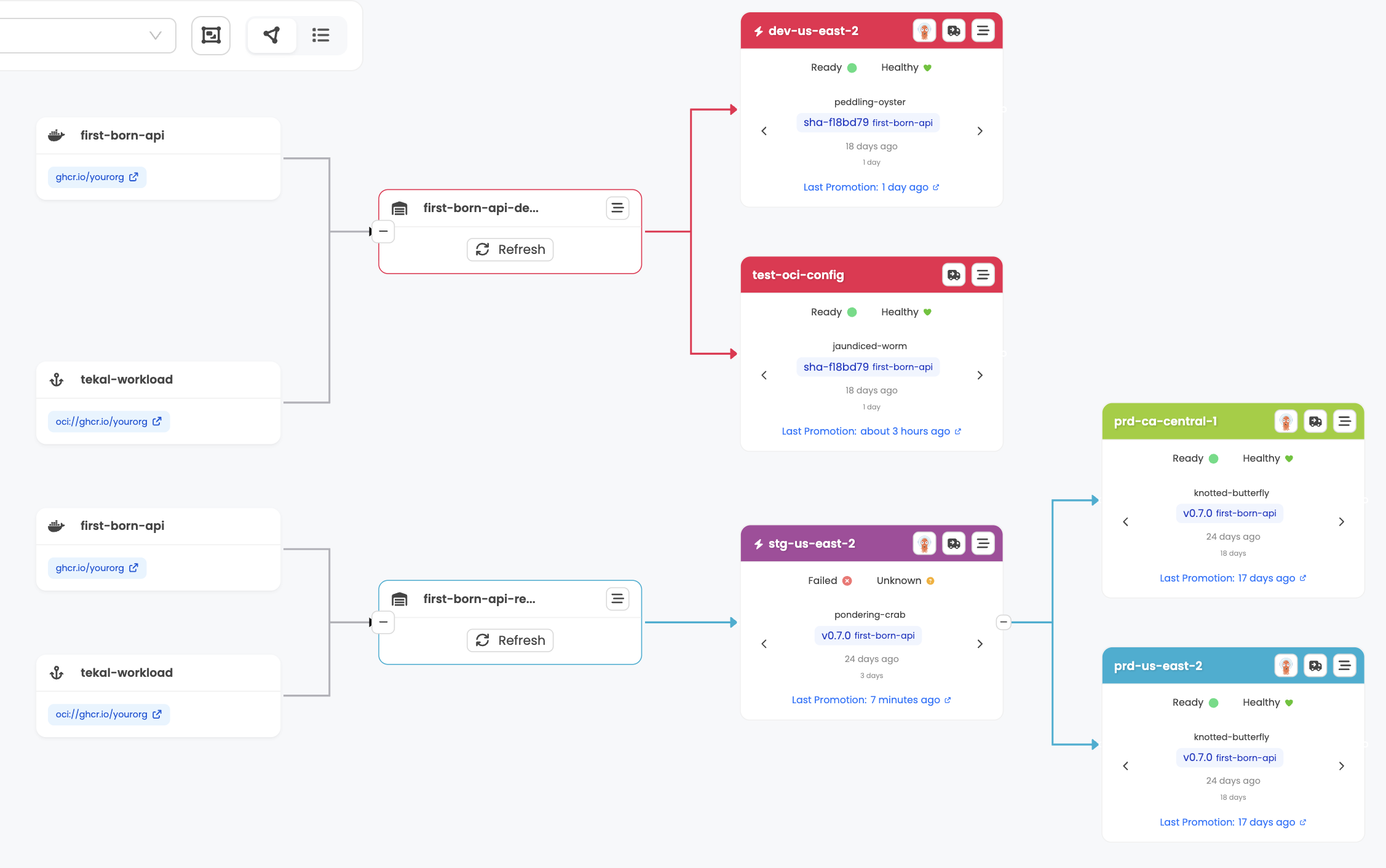
Kargo controls promotions. In staging, auto-promote. In production, manual gate per region. US and CA promote independently. Each region with its own gate, its own timing.
Config compilation comes from Starlark. service.star + deploy/prd-region.star produces the final values.yaml: replicas, resources, probes, secrets, env vars, everything. Kargo only updates image.tag via yaml-update during promotion.
The problem: if the CD pipeline commits the compiled values.yaml to the path ArgoCD watches, the deployment starts before Kargo promotes the image. New config with old image. In staging this doesn’t matter because Kargo promotes in seconds. In production with a manual gate, the window is hours.
And there’s another problem. Two writers to the same repo: the CD pipeline (compiled config) and Kargo (image tag). No atomic transaction. If both write at the same time, merge conflicts. If one writes first, inconsistency window.
What about multi-region? US and CA need different config artifacts. Same service, same version, different region. If both promote at the same time, concurrent git-push to the same repo.
Three intertwined problems. Solving one without the other three doesn’t work.
Before arriving at the solution, I went through four paths that didn’t work. Each had partial merit and a flaw that made me discard it.
A. Direct commit to the production path (like staging)#
What we already had in staging. The pipeline commits compiled config to the path ArgoCD watches. Kargo promotes afterward.
Why not: Not atomic. Config arrives first, image after. Auto-sync triggers deployment with new config and old image. In staging it works because Kargo promotes in seconds, but in production with manual gates, the window can be hours. Plus, two writers to the same repo without coordination.
Commit compiled config to an intermediate directory (/staged/prd/) that ArgoCD doesn’t watch. Kargo copies it to the final path during promotion.
Why not: Mutable. Someone can edit the staged file between the commit and the promotion. Contaminates git history with intermediate files. No signatures, no digest, fragile path-filter. And you still have two writers.
A custom step in Kargo that runs the CLI we built from Platform Engineering to compile config from Starlark at promotion time, directly in the cluster.
Why not: Operational burden. Every CLI update requires a container rebuild. Couples the promotion to a specific CLI version. Expands the cluster’s attack surface. Compilation tooling doesn’t belong in the CD control plane.
A custom step in Kargo that triggers a GitHub Actions workflow to commit the compiled config to the gitops repo.
Why not: External dependency. Asynchronous. The Kargo promotion doesn’t know if the workflow finished, and it’s not atomic. If GHA is down, the promotion hangs, adding unnecessary latency or timeouts.
Compile config at release time, package it as an OCI artifact, push it to the registry with a Cosign signature. Kargo downloads it at promotion time and puts it in the gitops repo together with the image tag in a single atomic commit.
Why it won: Immutable, signed, and auditable. A single writer to the gitops repo (Kargo). Config and image in one commit. Zero inconsistency window. No new tooling in the cluster. The same registry infrastructure you already use for images.
graph TD
    subgraph "Alternative evaluation"
        A["A: Direct commit
(like staging)"] -->|Not atomic| X[REJECTED]
        B["B: Staged directory
in gitops"] -->|Mutable, no signatures| X
        C["C: devex-cli
in cluster"] -->|Operational burden| X
        D["D: GHA dispatch
from Kargo"] -->|Async, not atomic| X
        E["E: OCI config
artifacts"] -->|Immutable + atomic| V[CHOSEN]
    end
Two pipelines. Total separation of responsibilities.
The release pipeline (CD) compiles, packages, and signs. Never touches the gitops repo. Kargo downloads, verifies, writes, and deploys. A single writer through an atomic commit.
sequenceDiagram
    participant CI as Release Pipeline
    participant GHCR as GHCR
    participant Kargo as Kargo (PRD)
    participant Git as devex-gitops
    participant Argo as ArgoCD

    Note over CI: semver tag -> pipeline starts
    CI->>CI: retag image
    CI->>CI: compile Starlark (all envs)
    CI->>GHCR: oras push config artifact
    CI->>GHCR: cosign sign (OIDC keyless)
    Note over GHCR: signed artifact, pinned by digest

    Note over Kargo: manual promotion approved
    Kargo->>GHCR: cosign verify (abort if fails)
    Kargo->>GHCR: oci-download @digest
    Kargo->>Git: copy values + yaml-update image.tag
    Kargo->>Git: git-commit (config + image, ONE commit)
    Kargo->>Git: git-push
    Kargo->>Argo: argocd-update
    Argo->>Argo: auto-sync deploys
The important part: the CD pipeline never writes to devex-gitops. Only Kargo does.
The same flow applies for development, staging, and production. What changes is the trigger and the promotion gate.
Environment
Trigger
OCI artifact tag
Kargo promotion
dev
Push to main
{svc}-sha-{hash}-dev-us-east-2
Auto-promote
stg
Semver tag
{svc}-v1.2.0-stg-us-east-2
Auto-promote
prd-us
Semver tag
{svc}-v1.2.0-prd-us-east-2
Manual
prd-ca
Semver tag
{svc}-v1.2.0-prd-ca-central-1
Manual
One pattern. No exceptions. No special paths for staging, no workarounds for production. Development and staging are the rehearsal for exactly what’s going to happen in production.
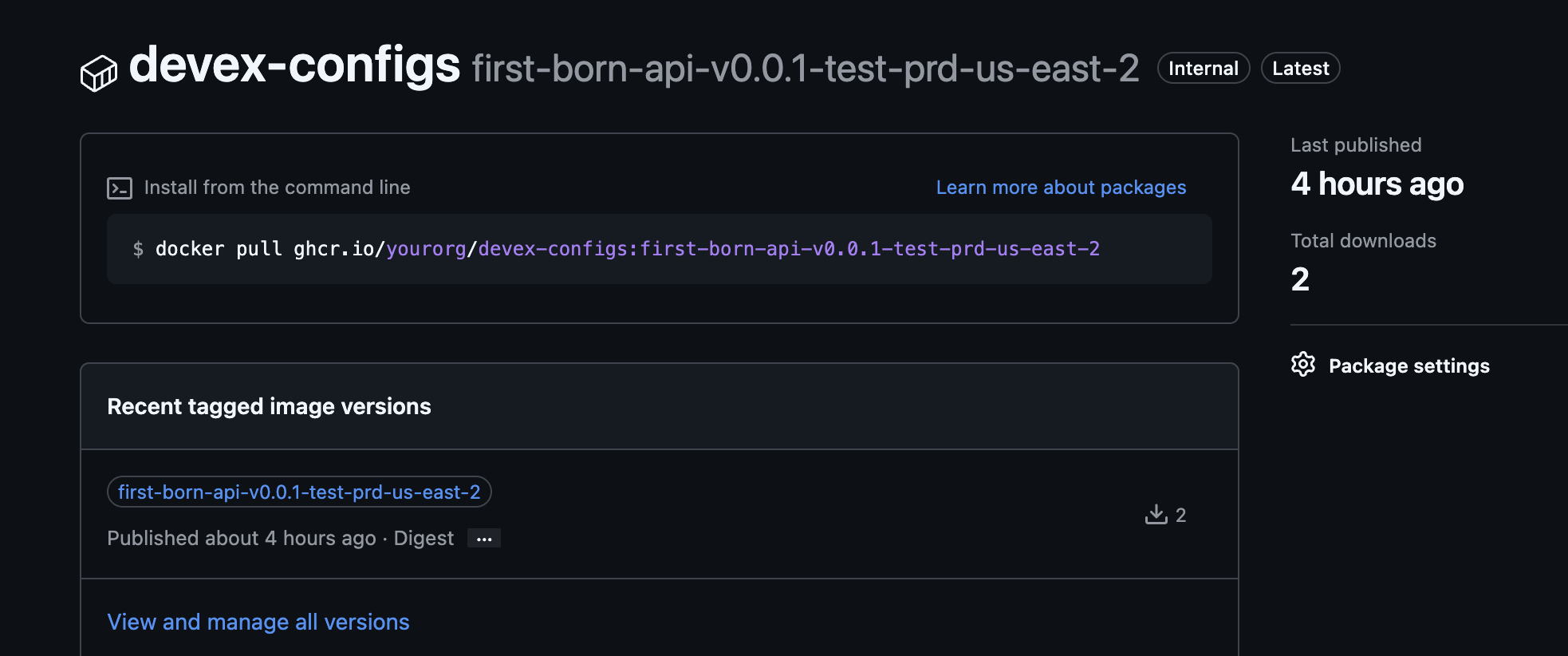
Three lines. oras push uploads the values.yaml as an OCI artifact with a custom media type. crane digest gets the exact digest. cosign sign signs with pipeline OIDC (Sigstore keyless, GHA workflow identity).
The artifact lives in the same GHCR where you already have your images. Same auth, same garbage collection, same billing.
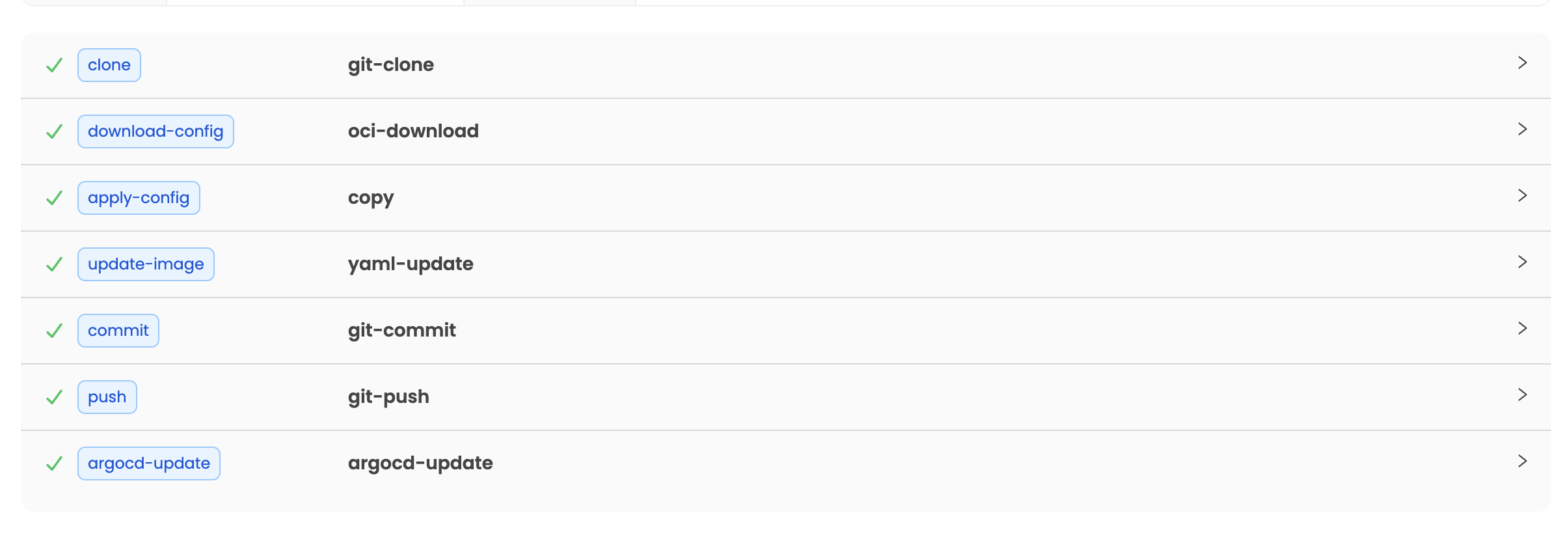
Seven steps. The two that matter are: oci-download (downloads the config artifact from the registry) and git-commit (config + image.tag in a single atomic commit).
The commit message includes the artifact tag. When an auditor asks “what config was deployed in this promotion?”, the answer is in the commit.
8 components validated before going to production:
Component
Status
oci-download with arbitrary artifacts
PASS
copy overwriting existing files
PASS
ORAS -> oci-download compatibility
PASS
ArgoCD + Argo Rollouts
PASS
argocd-update + multi-source
PASS
GHCR as OCI artifact store
PASS
Kargo auth to GHCR
PASS
Concurrent git-push (US + CA)
PASS
The complete end-to-end: 7 steps, ~5 seconds.
Step
Alias
Duration
Result
1
clone
1s
Cloned devex-gitops
2
download-config
1s
OCI artifact downloaded from GHCR
3
apply-config
<1s
values.yaml replaced with OCI content
4
update-image
<1s
image.tag updated from Freight
5
commit
<1s
Atomic commit (config + image.tag)
6
push
2s
Push to branch
7
argocd-update
<1s
ArgoCD syncs to exact commit
~5 seconds for a complete promotion. Config downloaded, applied, committed together with the image tag, pushed, and synced. No human in the loop and no external dependencies.
An extra detail that cost a fair bit of debugging: the argocd-update timeout in staging wasn’t a Kargo bug (issue #4020 as we initially suspected). It was a missing pull secret for GHCR. Kyverno wasn’t generating the secret in the service’s namespace. ArgoCD tried to sync, the pod couldn’t pull the image, timeout. The fix was a Kyverno ClusterPolicy, not a Kargo change.
The same pipeline you use for a deploy with new code works for a config change without code. The image retag produces the same digest, the OCI artifact has the new config, Kargo promotes when you approve.
No workarounds, no special paths, no “edit the values.yaml directly and pray”.
Nothing is free. Here’s what you gain and what you pay.
Aspect
OCI Gitless
Direct gitops push (like STG)
Atomicity
Config + image in one commit
Config arrives first, image after. Risk window
Gitops writer
Only Kargo (single writer)
CI + Kargo (two writers, possible conflicts)
Debugging
oras pull to inspect config (new skill)
git show (already known)
PromotionTask complexity
6 steps (oci-download + copy + yaml-update + …)
5 steps, one fewer
CI dependencies
ORAS in pipeline
Nothing new
Extra infra
OCI repo devex-configs + GC workflow
Nothing
Immutability
Registry is append-only, signable with Cosign
Git commit is mutable (force push, amend)
Rollback
oras pull any previous version
git show of the commit, depends on git history
The real cost is one thing: your team needs to learn to inspect OCI artifacts. oras pull instead of git show. It’s not hard, but it’s a new skill. If someone needs to see what config was deployed, they now go to the registry instead of git history.
The real benefit is also one thing: certainty. You know that what you compiled is exactly what got deployed. No ambiguity, no “did someone edit that file between the build and the deploy?”.
How much does this cost in storage? Almost nothing. A values.yaml weighs kilobytes.
Scale
Tags/month
Storage/year
Registry
20 services (today)
~160
~4 MB
GHCR
100 services
~800
~20 MB
GHCR
500 services
~4k
~100 MB
GHCR
1k services
~8k
~1.9 GB
GHCR (monitor quota)
3k+ services
~24k
~5.7 GB
Evaluate Harbor
GHCR scales seriously. We don’t need Harbor today. We probably won’t need it tomorrow. But we know it’s there in case we do.
When do you actually need Harbor?
Data residency regulation requiring infrastructure control
Regulatory audit requiring tag immutability as a compliance requirement
Multi-region artifact locality (Harbor replicates US <-> CA)
500+ services with complex retention policies
The migration is a URL change per service in the configRepo variable of the PromotionTask. Same OCI convention, same Kargo flow, zero changes in promotion logic.
If you work in healthcare, fintech, or any regulated industry, this matters to you. Every step in the flow leaves a verifiable record.
graph TD
    A["release tag (vX.Y.Z)"] --> B["pipeline run
(GHA run id, source commit SHA)"]
    B --> C["OCI push
(digest sha256:..., cosign signature, SLSA L3)"]
    C --> D["Kyverno verify
(admission policy validates signature)"]
    D --> E["Kargo promotion
(Promotion CR: Freight id, approver, timestamp)"]
    E --> F["git commit
(config-artifact tag)"]
    F --> G["ArgoCD sync
(synced revision = that commit)"]
From the release tag to the ArgoCD sync, each link points to the previous one. If an auditor asks “what exactly was deployed to production on Tuesday at 3pm?”, you trace the complete chain.
The git commit in the gitops repo includes the artifact tag. The tag points to the artifact in GHCR. The artifact has a Cosign signature with the pipeline’s OIDC identity. The signature points to the GHA workflow. The workflow points to the source code commit, and the commit has the semver tag.
Cosign signs the artifact in CD. Where is it verified?
Kargo OSS doesn’t support custom steps with arbitrary containers (that’s Akuity Platform Enterprise). But verification doesn’t need to live inside Kargo. There are two real options:
Option 1: Kyverno as admission policy. A ValidatingPolicy that intercepts Kargo Promotions and verifies the OCI artifact signature before admitting them. If the signature isn’t valid, the Promotion doesn’t even start. Enforcement stays in the Kubernetes control plane, not in the pipeline.
Option 2: Verify in CI, trust the tag. The release pipeline signs with Cosign via OIDC. The artifact tag includes the release version, and only the release workflow can push (OIDC identity). Since the tag is never republished (one version = one tag = one digest), immutability is by process. It’s not the same as cryptographic verification in the promotion path, but for many teams it’s sufficient.
We validated Cosign sign + verify locally during implementation. The round-trip works: cosign sign in CI, cosign verify with the correct OIDC issuer. The pending piece is automatic enforcement, which we implemented with Kyverno.
Promotion fails; concurrency limit prevents the race condition
Artifact without signature (with Kyverno)
Kyverno rejects the Promotion before it starts
If Kargo says the promotion was successful, the artifact was downloaded, config and image.tag were committed together, and ArgoCD synced.
Region isolation is guaranteed by a Kyverno ValidatingPolicy, not just a naming convention. If someone tries to apply US config in the CA namespace, Kyverno rejects it at admission control level.
Documentation for the step that makes this possible
Google documents it. Flux implements it. Harbor supports it natively. ArgoCD 3.1 ships it out of the box. Netflix has been doing it for years with Spinnaker, and the Kargo community explicitly requested it.
Compiled config is not a file. It’s build output. It deserves the same treatment as a Docker image: immutable, versioned, signed, verified before deploying.
If you have auto-sync in production and your compiled config lives as a file in git, the question isn’t whether you’ll have an atomicity incident. It’s whether you really want to live with it catching you when you least expect it.
The solution isn’t to turn off auto-sync, or stop compiling config, or add fragile path-filters. It’s to treat your config as what it is: an artifact in your supply chain. Package it, sign it, let your promotion controller download it and apply it atomically with the image.
One pipeline, one pattern, all environments. Zero extra writers to the gitops repo. Zero inconsistency windows. ~5 seconds end to end.